

A compromised industrial roof is the fastest way to hemorrhage equity during a facility turnover. Investors don't just buy square footage; they buy the long-term integrity of the building envelope. If your roofing membrane is failing or your drainage systems are compromised, you're handing the buyer a massive negotiation lever. Understanding how to liquidate commercial property assets effectively starts with a roofing-first recovery protocol. It's about protecting the asset from the top down to ensure the highest possible valuation at the closing table.
You want to minimize time-on-market while securing the highest possible recovery value for your physical infrastructure. We agree that logistical complexity and uncertainty about roof health often stall these high-stakes transitions. This guide provides the strategic blueprint for maximizing your property's value through targeted roofing prep and industrial-grade recovery protocols. We'll examine the critical role of roof integrity in asset valuation, the execution of heavy-duty site prep for roof assessments, and the importance of a decisive partner who masters the logistics of scale.
Key Takeaways
- Identify the industrial roofing system as the critical protective envelope that dictates the final property valuation and capital recovery.
- Master how to liquidate commercial property assets by utilizing core samples and structural audits to verify membrane integrity for prospective buyers.
- Evaluate the financial ROI of high-performance silicone roof coatings versus full industrial replacements to maximize short-term liquidation value.
- Execute precise site decommissioning by clearing roofing-level obstructions and ensuring all exterior drainage systems are fully operational for inspection.
Strategic Asset Liquidation: Why Your Roof Dictates Property Value
Commercial property liquidation is the systematic conversion of physical assets into capital. It is a high-stakes transition where every structural component is scrutinized for its impact on the bottom line. In this environment, the roof serves as the protective envelope of the property's financial value. It's the first line of defense for the building's interior and the first item on a buyer's checklist. If the envelope is compromised, the capital recovery value plummets. Savvy industrial buyers in 2026 demand roof condition reports before they even review the P&L statements. They recognize that a failing membrane is not just a repair; it's a massive financial liability that can stall a transaction. Our boots-on-the-ground perspective is absolute: physical integrity must precede financial liquidity. Understanding how to liquidate commercial property assets effectively requires a focus on the roof as the primary driver of building equity.
The Roof-to-Value Correlation in PA Real Estate
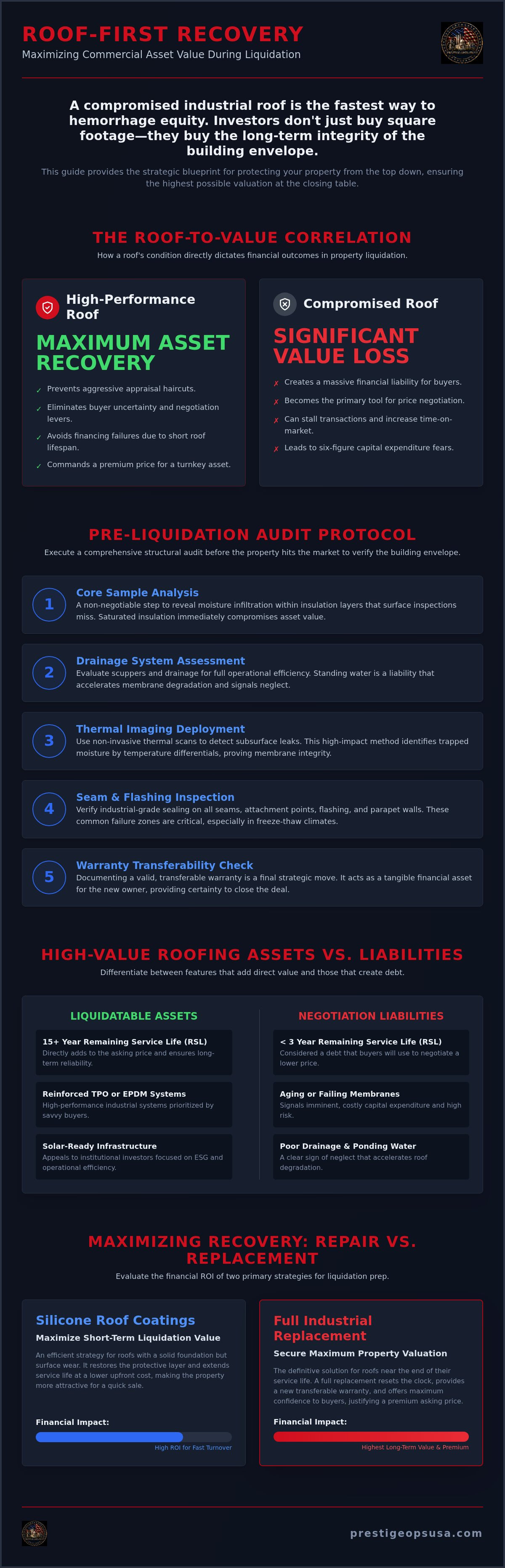
Industrial buyers in Philadelphia, Allentown, and Reading prioritize structural lifecycle over surface-level aesthetics. They are looking for long-term reliability in harsh Northeastern climates. A certified roofing inspection is the most powerful tool in your liquidation arsenal. It prevents buyers from hitting a maturity wall, where financing failures occur because the roof's remaining life is shorter than the loan term. When you provide a documented history of exterior maintenance, you eliminate the uncertainty that leads to aggressive appraisal haircuts. Buyers will pay a premium for a building that won't require a six-figure capital expenditure within the first twenty-four months of ownership. In the Pennsylvania market, a verified high-performance roof is the difference between a decisive sale and a property that sits on the market for months.
Identifying High-Value Roofing Assets
Not all roofs are created equal when you are preparing for a liquidation. You must differentiate between standard flat roofs and high-performance industrial systems like reinforced TPO or EPDM. Assessing the Remaining Service Life (RSL) of these systems is critical for asset recovery. An RSL of fifteen years is a liquidatable asset that adds direct value to the asking price. Conversely, an RSL of three years is a debt that the buyer will use to negotiate a lower price. We also see a significant shift toward solar-ready roofing systems in modern commercial valuations. These roofs are designed with the structural load capacity and membrane durability to support renewable energy infrastructure. Positioning your property as solar-ready can significantly increase its appeal to institutional investors who are focused on ESG metrics and long-term operational efficiency.
Evaluating Industrial Roofing Systems During Decommissioning
Success in a commercial sale depends on the absence of surprises. You must execute a comprehensive structural audit before the property ever hits the market. It's the only way to verify the building's envelope. Analyzing core samples is a non-negotiable step in this process. These samples reveal moisture infiltration within the insulation layer that surface inspections often miss. If the insulation is saturated, your asset's value is compromised. You need to know this before a buyer's inspector finds it. Assessing drainage systems and scuppers for operational efficiency is equally vital. Standing water is a liability. It accelerates membrane degradation and signals neglect to prospective investors. Documenting roof warranty transferability is your final strategic move. A valid, transferable warranty is a tangible financial asset for the next owner. It provides the certainty required to close complex deals. Understanding how to liquidate commercial property assets requires a clear-eyed look at the roof's current condition.
Industrial Roofing Audit Protocols
Precision is mandatory during the audit. Deploy thermal imaging to detect subsurface leaks without destructive testing. This technology identifies temperature differentials that indicate trapped moisture. It's a high-impact, non-invasive method to prove membrane integrity. Whether you have TPO, EPDM, or PVC systems, the seams and attachment points must be verified. Check flashing and parapet walls for industrial-grade sealing. These transition points are common failure zones. In regions like Philadelphia and Allentown, freeze-thaw cycles make flashing integrity even more critical. Ensuring they are watertight is essential for maintaining the property's recovery value. If you need a professional assessment of your system's current state, consider an industrial roofing audit to secure your investment.
The Decommissioning Checklist for Facility Managers
Facility managers must lead the decommissioning timeline. It involves more than locking doors. You must shut down roof-mounted HVAC units and properly seal all penetrations. Open vents or unsealed curbs are entry points for moisture and pests. Clearing debris from commercial gutters is another priority. Clogged drainage leads to structural water damage during the sale phase. This damage is avoidable. Finally, you must secure all roof access points. Mitigating liability during property vacancy is a logistical necessity. A vacant building with an accessible roof is a high-risk asset. These steps ensure the property remains in peak condition while you determine how to liquidate commercial property assets for maximum return.
Maximizing Asset Recovery: Roof Repair vs. Replacement for Liquidation
Asset recovery is a numbers game. When you determine how to liquidate commercial property assets, you must decide whether to repair or replace the existing roofing system. Buyers use a failing roof as a high-leverage negotiation weapon. They typically demand a discount that far exceeds the actual cost of a professional remediation. If a buyer identifies a leak, they won't just ask for the repair cost; they'll demand a massive "As-Is" haircut to cover the perceived risk. Professional remediation before listing the property removes this fear factor. It allows you to maintain control of the narrative and the price. A well-maintained roof signals to prospective investors that the entire building envelope is sound. It suggests a history of disciplined management that buyers find reassuring during the due diligence phase.
Silicone roof coatings are a strategic middle ground for liquidation. If your building has a 5-year to 10-year buyer window, a full tear-off is rarely the best financial move. A high-solids silicone coating provides a seamless, leak-free surface and a fresh warranty at a fraction of the replacement cost. It turns a liability into a documented asset. You deliver a watertight building with a renewable warranty, allowing the buyer to defer major capital expenditures. This approach maximizes your immediate recovery value while ensuring the building passes a rigorous industrial inspection.
When to Invest in a New Industrial Roof
Institutional buyers and REITs prioritize zero-CapEx assets. They want to acquire a property and move straight to operations without structural distractions. Calculating the Internal Rate of Return (IRR) on a new roof installation prior to sale often reveals a significant upside. A new roofing system with a 20-year NDL (No Dollar Limit) warranty is a massive selling point that justifies a premium asking price. It eliminates the "maturity wall" for buyer financing and simplifies the appraisal process. While the upfront cost is higher, the speed of the transaction and the elimination of price chipping often result in a higher net recovery during the liquidation year.
The Case for Strategic Exterior Maintenance
Targeted repairs are the key to securing a "Clean" building inspection report. In competitive industrial parks in Allentown and Collegeville, curb appeal and structural integrity go hand-in-hand. You don't always need a full replacement to protect your equity. Targeted patching of membrane seams and professional cleaning of drainage systems can stabilize a roof for the sale. We focus on high-impact areas: flashing, scuppers, and penetrations. These are the zones where inspectors look first. A proactive exterior maintenance plan ensures that your property stands out as a turn-key solution, rather than a project for the next owner.
The Step-by-Step Logistics of Industrial Property Asset Liquidation
Liquidation is a logistical operation that demands methodical execution. It is not a simple cleaning process. You must treat the physical building as a series of recoverable assets. The first step is to conduct a full-site inventory. This includes identifying surplus roofing materials, insulation rolls, and metal flashing stored in staging areas. You must also account for roof-mounted equipment and the electrical systems that power them. Once the inventory is complete, you move to the industrial facility cleanout. This step focuses on removing debris and non-liquid assets from the roof surface and exterior perimeter. A clean roof allows for a final, accurate assessment of the building envelope. Securing this envelope is Step 3. You must ensure all penetrations are sealed and the membrane is watertight. Step 4 involves brokering surplus industrial assets. This includes selling excess roofing inventory and electrical components like transformers or switchgear. The final step is the site turnover. You hand over a facility that is watertight, broom-clean, and ready for immediate buyer occupancy. Mastery of these logistics is essential when you determine how to liquidate commercial property assets for maximum capital recovery.
Industrial Cleanout and Site Decommissioning
Precision is required when clearing industrial debris. In Philadelphia and Reading, facility managers must manage the removal of roofing scrap and abandoned HVAC components with professional speed. You cannot leave industrial waste to clog drainage systems during the sale phase. We ensure the facility is broom-clean at the roof level and across the exterior grounds. This level of decommissioning removes obstacles for inspectors and prospective buyers. It presents a disciplined, well-managed asset that commands a higher price. If you are preparing a large-scale facility for market, you need a partner who understands the logistics of industrial roofing cleanouts to maintain your property value.
Electrical and Industrial Surplus Brokering
Asset recovery extends to the high-value electrical infrastructure supporting your roofing systems. During liquidation, you must identify valuable electrical surplus such as breakers and transformers. These components often power the heavy-duty HVAC units mounted on industrial roofs. Brokering this excess equipment provides a direct cash infusion that offsets the costs of the property cleanout. We connect you with industrial buyers to recover capital from these hidden assets. Instead of treating old switchgear as scrap, we treat it as a liquidatable asset. This integrated approach ensures that every component of your building's exterior and roofing infrastructure contributes to the final recovery total. It is a critical part of the strategy for how to liquidate commercial property assets in the Pennsylvania industrial corridor.
Prestige Operations: Industrial Asset Recovery and Roofing Mastery in PA
Prestige Operations stands as the decisive partner for large-scale facility turnovers across the Pennsylvania industrial corridor. We bring industrial-strength reliability to every project in Philadelphia, Allentown, and Reading. Our team understands that when you determine how to liquidate commercial property assets, the roofing system is your primary leverage point. We provide the specialized labor and logistical mastery required to stabilize this asset before it hits the market. Our integrated care approach combines technical roofing expertise with comprehensive site decommissioning. This ensures your building envelope is secure and your recovery value is maximized. We operate with a no-nonsense, boots-on-the-ground demeanor that prioritizes execution over empty promises.
Why Pennsylvania Facility Managers Trust Prestige
Facility managers across the state rely on our mastery of industrial roofing systems and exterior maintenance. We don't offer generic solutions. We provide decisive execution in high-stakes environments where property turnovers must happen on a strict timeline. Our local expertise includes a deep understanding of Pennsylvania industrial and commercial codes. We ensure your roofing system meets 2026 standards to prevent regulatory delays during the due diligence phase. Whether you're managing a warehouse in Collegeville or a manufacturing plant in Reading, we deliver the reliability your project demands. We focus on the functional and the logistical, ensuring every scupper, seam, and flashing point is verified for the next owner.
Initiating Your Liquidation Protocol
Starting the recovery process is a matter of professional motion. You can request an integrated roofing and cleanout assessment to identify immediate liabilities and hidden assets. Our site audit is thorough but fast-paced. We analyze membrane health, insulation moisture levels, and the transferability of existing warranties. We also inventory surplus roofing materials and associated industrial equipment that can be brokered to offset your decommissioning costs. You'll receive a disciplined, serious evaluation of your property's physical standing. This roadmap allows you to move forward with the confidence that your building envelope is a confirmed asset rather than a negotiation risk.
To secure your property's value and receive a professional assessment, Contact Prestige Operations for a Decisive Liquidation Quote. We are the strategic asset you need to navigate the complexities of how to liquidate commercial property assets with precision and efficiency. Our team is ready to deploy and stabilize your facility for a successful turnover.
Secure Your Equity Through Strategic Roofing Recovery
Maximizing property value requires a top-down approach. A verified roofing membrane is the most critical asset in your portfolio during a facility turnover. By prioritizing structural audits, sealing penetrations, and brokering surplus industrial roofing inventory, you eliminate the negotiation levers buyers use to chip away at your price. This integrated strategy is the most efficient path for those learning how to liquidate commercial property assets without sacrificing equity.
Prestige Operations delivers industrial-strength reliability across Philadelphia, Reading, and Allentown. We master the logistics of complex facility turnovers to ensure your building envelope is secure and your recovery value is optimized. Our expertise in industrial roofing and exterior maintenance provides the decisive partnership needed for high-stakes transitions. Your facility is ready for its next chapter. Ensure it starts with a watertight foundation and a clear recovery plan.
Secure Your Assets: Request a Decisive Liquidation and Roofing Quote
Frequently Asked Questions
What is the fastest way to liquidate commercial property assets in Pennsylvania?
The fastest way is to secure a certified roof condition report immediately. Buyers stall when the building envelope is a question mark. A watertight certification for your TPO or EPDM system accelerates the due diligence period. It transforms the roof from a liability into a verified asset. This is a critical step in how to liquidate commercial property assets with speed and precision.
Does a bad roof affect the appraisal of a commercial building during liquidation?
A compromised roofing system causes aggressive appraisal haircuts. Appraisers don't just deduct the cost of a new membrane; they factor in potential structural damage. A failing roof signals deferred maintenance across the entire facility. Securing a professional repair or coating before the appraisal protects your equity. It ensures the building's protective envelope supports a high valuation.
Can I sell industrial surplus equipment like electrical components during a property cleanout?
You can broker high-value electrical surplus during the decommissioning process. We focus on the switchgear and transformers that support your roof-mounted industrial HVAC infrastructure. Selling these components offsets the cost of exterior maintenance. It turns abandoned rooftop power systems into immediate capital. This integrated recovery approach maximizes the total value of your building's physical infrastructure.
How much does a commercial property cleanout cost in Philadelphia?
Cleanout costs are determined by the volume of industrial debris and the complexity of roof-level access. Removing abandoned roofing materials and abandoned rooftop units requires specialized labor. Philadelphia's industrial codes demand proper disposal of roofing scrap and hazardous materials. We provide comprehensive quotes based on the specific logistical requirements of your facility's exterior and rooftop decommissioning.
Is it better to repair or replace a commercial roof before selling?
It's often better to apply a high-performance silicone coating if the underlying insulation is dry. A full replacement is a massive capital expenditure that you might not recover. A silicone coating provides a fresh warranty and a leak-free surface for the next owner. It's a strategic move for how to liquidate commercial property assets while maintaining a high ROI.
What are the common mistakes in industrial facility decommissioning?
The most common mistake is failing to seal roof penetrations after equipment removal. Unsealed curbs and vents allow moisture to destroy the insulation layer. Ignoring commercial drainage systems is another critical error. Clogged scuppers lead to standing water that compromises the membrane integrity during the sale window. These oversights result in deal-killing inspection reports.
How do I find industrial electrical surplus buyers in PA?
Finding buyers for industrial electrical surplus is best handled by integrated recovery experts. We connect you with buyers specifically interested in the infrastructure that supports large-scale roofing and HVAC systems. This includes transformers, breakers, and heavy-duty switchgear. We manage the logistics of removal from the rooftop or exterior staging areas to ensure a clean turnover.
What paperwork is required for commercial property liquidation in Reading, PA?
You'll need documented proof of roof integrity and warranty status. Reading, PA, buyers demand transferable NDL warranties and recent maintenance logs. You should also have records of any permitted roofing repairs or structural modifications. Providing a complete exterior maintenance history builds the trust necessary to close industrial liquidations in the Berks County market.


